
Overview |
AMReX |
People |
Publications |
Jean M. Sexton
CSE, Applied Mathematics and Computational Research Division
|
Contact InformationJean SextonMS 50A-3111 Lawrence Berkeley National Lab 1 Cyclotron Rd. Berkeley, CA 94720 510-486-6900 (fax) |
|
Affiliation and Research Interests
I am a CSE member in the Center for Computational Sciences and Engineering (CCSE) in the Computing Sciences Area at Lawrence Berkeley National Laboratory. My work spans two interconnected areas: performance-portable HPC simulation development and AI-driven automation for scientific computing workflows. On the simulation side, I develop and maintain AMReX-based applications including Nyx, REMORA, and ERF, with a focus on scalable parallelism, exascale performance, and multiphysics coupling. On the AI side, I build agentic systems that automate the end-to-end lifecycle of HPC simulations from natural-language prompts through configuration, job execution, and result analysis, and I apply LLM-assisted tooling to code modernization and documentation tasks. Much of my work is open source and can be followed on my GitHub page. A curated set of links to my current projects, talks, and code is available at linktr.ee/jmsexton03.
Projects (Active and Recent)
AMReX Agent: I am developing a framework-aware agentic system that accepts natural-language prompts and automates the full simulation lifecycle for AMReX-based HPC applications: planning, configuration generation, job submission and monitoring via SFAPI, result retrieval, and analysis/visualization. A schema-guided reflexion loop (iterative validation and correction) improves generated run reliability without manual intervention. Domain-focused variants include Pele Agent (combustion), ERF Agent (atmospheric workflows), and REMORA Agent (ocean workflows). This work includes collaboration with emmashie/model-agent. Source links are curated at Agentic Workflows for AMReX.
Document Automation: I built a multi-source retrieval and synthesis pipeline for PDF, PDF+TeX, and arXiv inputs using hybrid retrieval (embedding-based ranking plus lexical ranking), model-aware context controls, and automated figure/text extraction. The workflow supports iterative draft-and-refine pathways for reproducible scientific highlight-slide generation and informed two NERSC SPOT recognitions in 2025.
AI-Assisted Code Modernization: I apply LLM-based tooling to support translation of legacy Fortran90 physics modules into performance-portable C++ for ERF, including MYNN microphysics and Morrison moisture schemes from WRF community physics. This work uses schema- and rule-aware validation workflows plus tooling experiments for migration support.
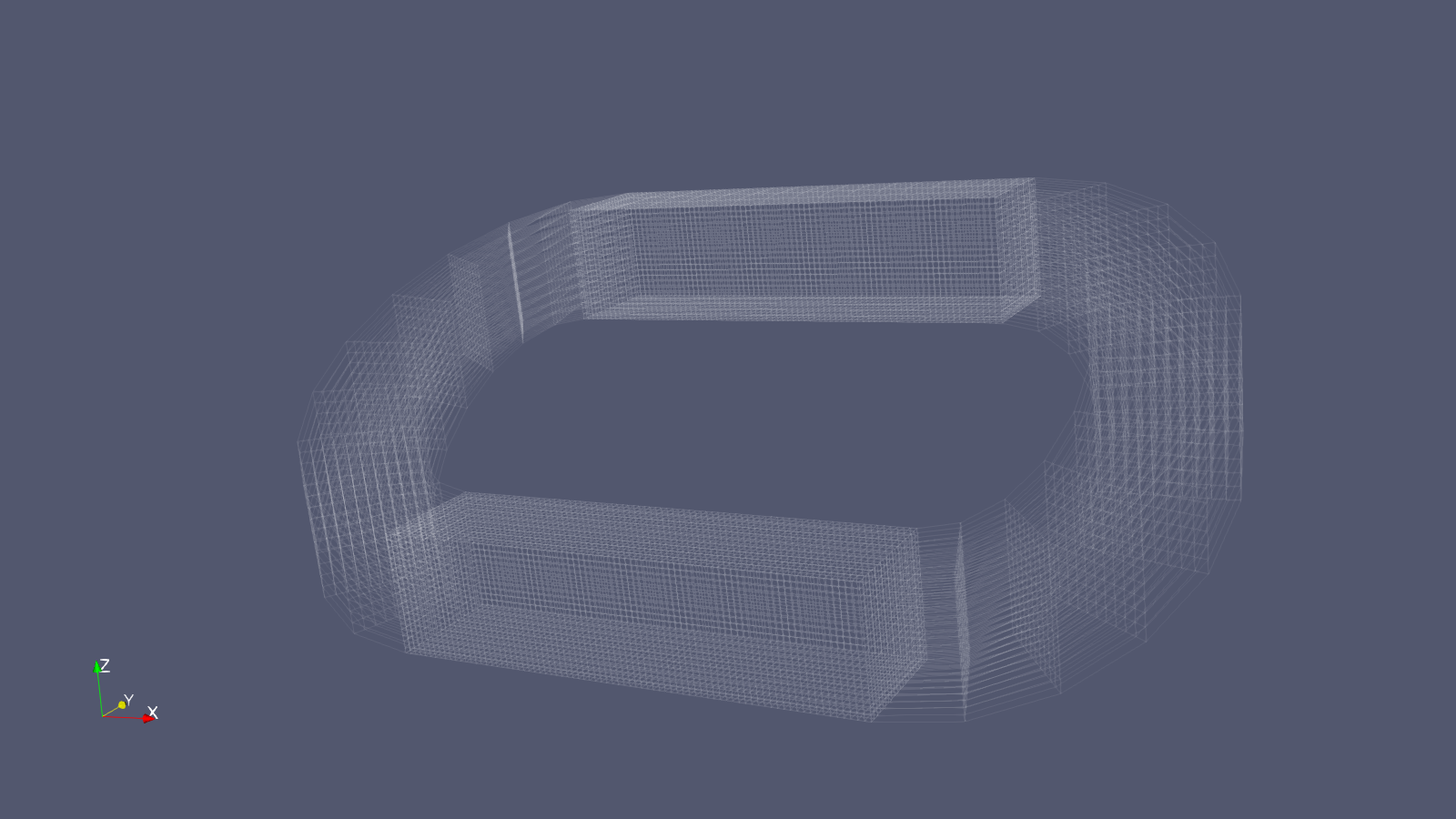
| MFEM-AMReX Integration: I am developing and implementing the coupling interface between MFEM and AMReX frameworks. Our proof-of-concept demonstrations successfully show scalar advection by prescribed velocity fields using coupled AMReX-based and MFEM advection solvers. The coupled simulations transparently handle data exchange and parallel coordination, with results viewable in visualization tools like ParaView. We have demonstrated multiple AMReX and MFEM disjoint regions in the same simulation, with AMReX exploiting block-structured AMR capability and MFEM utilizing unstructured, curved meshing capability. I have collaborated closely with the external MFEM team to align design, perform joint code reviews, and resolve integration challenges. More information about the MFEM-AMReX effort can be found at amrex-codes.github.io/mfem-amrex. |
 |
REMORA Enhancements: I have significantly enhanced this new GPU-enabled regional ocean modeling code built on AMReX, including supporting build system updates for its MOAB interface and enabling hierarchical parallelism (MPI+X with OpenMP, CUDA, HIP, SYCL). This capability is crucial for scaling ocean modeling to HPC systems and enables more sophisticated multiphysics ocean modeling. For more details, see the publication: "REMORA: Regional Modeling of Oceans Refined Adaptively (built on AMReX)" (Journal of Open Source Software, 2025). Project links: REMORA on GitHub | REMORA 0.1 Documentation.
ERF and SUNDIALS Integration: I support build system updates for MultiBlock coupling with external codes like AMR-Wind and WW3. My collaboration with the SUNDIALS team has achieved significant performance improvements, including a 2x overall speedup in Nyx heating-cooling runtime and GPU performance gains through optimized memory management and fused kernels. This work is detailed in the publication: "SUNDIALS time integrators for exascale applications with many independent systems of ordinary differential equations" (The International Journal of High Performance Computing Applications, 2025). In 2024-2025, this work expanded to include AI-assisted translation of WRF community physics modules (MYNN microphysics, Morrison moisture schemes) into performance-portable C++ using LLM-based tooling. Project links: ERF on GitHub | ERF 0.1 Documentation.
|
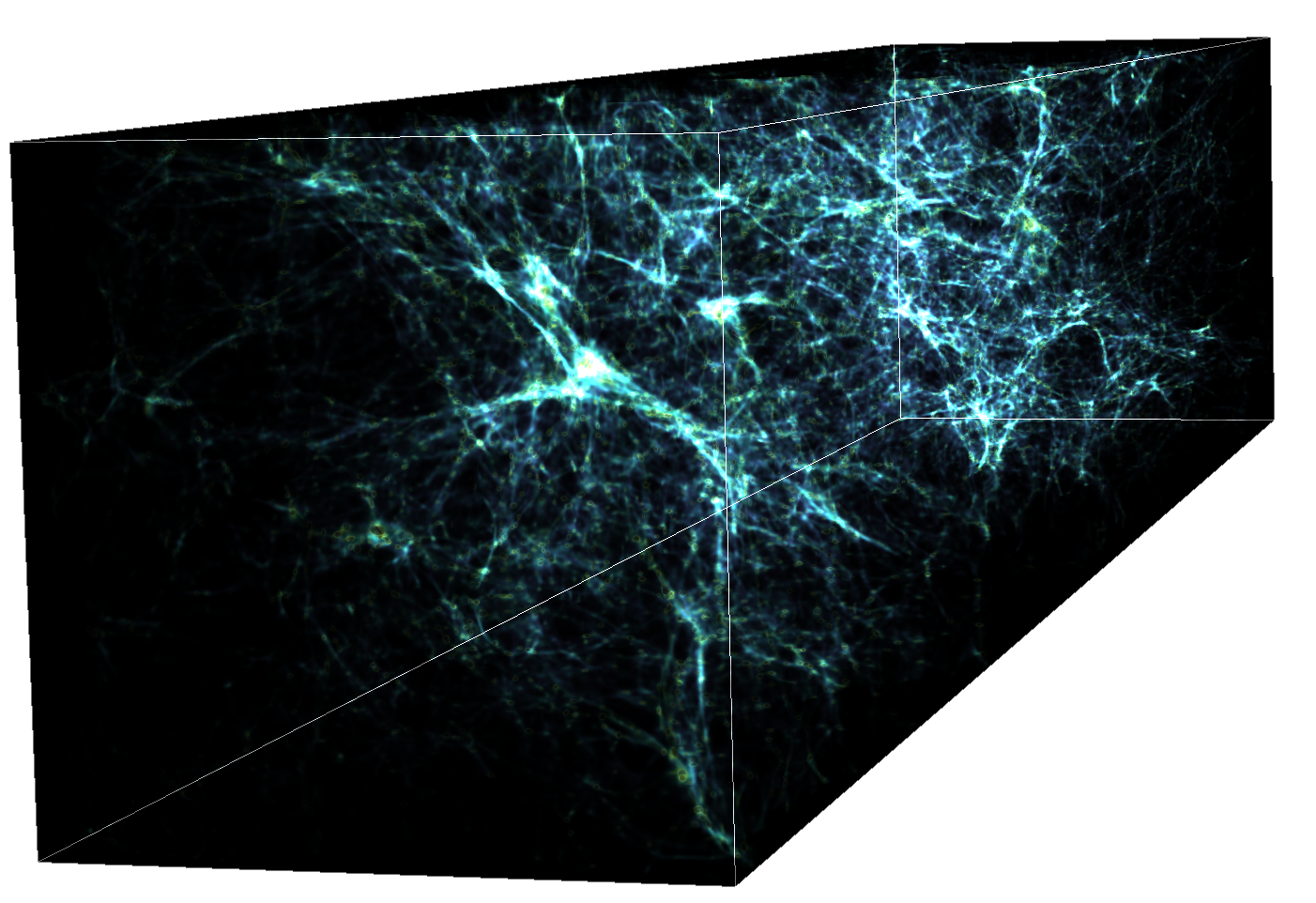
Nyx Cosmological Simulations: I am a key contributor to the Nyx cosmological simulation code. I co-authored the paper documenting the code: "Nyx: A Massively Parallel AMR Code for Computational Cosmology" (Journal of Open Source Software, 2021). My work includes stress-testing GPU performance and optimizing load-balancing, and interfacing the code with on-the-fly halo-finders. I am a co-author on major simulation suites including the ACCEL2 project and the Lyssa suite of high-resolution cosmological simulations. I also contribute to the code's development directly through its official GitHub repository. |
General AMReX Development: I contribute to improving the performance portability and interoperability of AMReX and AMReX-based applications. I am a co-author on the AMReX Zenodo Release.
Awards and Recognition
 2025 - Recognition of Excellence SPOT Award: “For your great work creating and demonstrating for your colleagues a method for using AI to create a PowerPoint slide.”
2025 - Recognition of Excellence SPOT Award: “The QSA team recognizes Jean for her efforts in customizing code that she created to specifically aid in QSA's renewal efforts by automating reporting slides. Her willingness to share her talents is a true example of team science.”
2022 - Recognition of Excellence SPOT Award: “For extraordinary efforts debugging Slingshot software issues during Perlmutter Phase II integration on a very short time scale.”
2022 - Recognition of Excellence SPOT Award: “For many hours of work in helping to reproduce, understand, and debug a Mellanox driver/memory pressure issue on Perlmutter during its early access period.”
2022 - Safety Recognition Award Program: “For supporting our safety culture and the prevention of injuries by addressing slip/trip/fall hazards in the 50 Complex.”
Previous Work
My research career has evolved from developing fundamental numerical methods for time integration to applying these techniques in large-scale computational physics applications.
As a postdoctoral researcher in CCSE, I worked on improving efficiency for simulations involving time integration methods, including the AMReX-based applications Nyx and Castro. I primarily worked on the Nyx N-body hydro code for computational cosmology. Cosmological simulations allow us to investigate physical parameters which are not directly observable.
This work included porting Nyx to GPU's, and transitioning to a fully C++ code for performance portability and maintainability. More efficient numerical methods and improved parallelism allow for more highly refined and complex models. Part of this work was algorithmic improvements, including adapting known splitting methods to a cosmological setting. Specifically, I improved the numerical coupling between the hydrodynamic solver and the integration of the heating and cooling source terms as well as the overall algorithm efficiency. I implemented a spectral deferred correction coupling strategy (which accounts for the comoving frame) in order to improve Nyx's heating-cooling integration efficiency and robustness.
I received my doctorate in Computational and Applied Mathematics from Southern Methodist University in late 2017. My dissertation research focused on the development of numerical methods for the time integration of problems with multiple characteristic time scales. These methods are motivated by multiphysics, multiscale real-world application problems which are constructed by coupling physical processes with potential disparate length and time scales together. I developed a family of efficient, fully coupled fourth-order multirate methods, based on existing Recursive Flux-Splitting Multirate methods, and analyzed their order conditions using Generalized Additive Runge-Kutta theory. An early work from this period is "Relaxed Multirate Infinitesimal Step Methods: an extension of Multirate Infinitesimal Step Methods and Recursive Flux-Splitting Multirate Methods". I am also listed as an "Other contributor" to the SUNDIALS library itself and as a "Contributor" to the MFEM code, reflecting my involvement earlier in my career. I was a co-author on the Nyx, Castro, and AMReX publications.
Selected Publications
Klion, H., Hetland, R., Sexton, J., Almgren, A., Grindeanu, I., Hinson, K., & Mahadevan, V. (2025).
REMORA: Regional Modeling of Oceans Refined Adaptively (built on AMReX).
The Journal of Open Source Software, 10(110), 7958.
[doi]
Walther, M., Schöneberg, N., Chabanier, S., Armengaud, E., Sexton, J., Yèche, C., Lesgourgues, J., Mosbech, M. R., Ravoux, C., Palanque-Delabrouille, N., & Lukić, Z. (2025).
Emulating the Lyman-Alpha forest 1D power spectrum from cosmological simulations: new models and constraints from the eBOSS measurement.
Journal of Cosmology and Astroparticle Physics, 2025(05), 099.
[doi]
de Belsunce, R., Chen, S.-F., Ivanov, M. M., Ravoux, C., Chabanier, S., Sexton, J., & Lukić, Z. (2025).
Precision measurements of EFT parameters and BAO peak shifts for the Lyman-α forest.
Physical Review D, 111(6), 063524.
[doi]
Balos, C. J., Day, M., Esclapez, L., Felden, A. M., Gardner, D. J., Hassanaly, M., Reynolds, D. R., Rood, J., Sexton, J. M., Wimer, N. T., & Woodward, C. S. (2025).
SUNDIALS time integrators for exascale applications with many independent systems of ordinary differential equations.
The International Journal of High Performance Computing Applications, 39(1), 123-146.
[doi]
Chabanier, S., Ravoux, C., Latrille, L., Sexton, J., Armengaud, É., Bautista, J., Dumerchat, T., & Lukić, Z. (2024).
The ACCEL2 project: simulating Lyman-α forest in large-volume hydrodynamical simulations.
Monthly Notices of the Royal Astronomical Society, 534(3), 2674-2693.
[doi]
Park, H., Lukić, Z., Sexton, J., Alvarez, M. A., & Shapiro, P. R. (2024).
Impact of Self-shielding Minihalos on the Lyα Forest at High Redshift.
The Astrophysical Journal, 969(1), 46.
[doi]
Wang, D., Pulido, J., Grosset, P., Tian, J., Jin, S., Tang, H., Sexton, J., Di, S., Lukić, Z., Zhao, K., Fang, B., Cappello, F., Ahrens, J., & Tao, D. (2023).
AMRIC: A Novel In Situ Lossy Compression Framework for Efficient I/O in Adaptive Mesh Refinement Applications.
[doi]
Chabanier, S., Emberson, J. D., Lukić, Z., Pulido, J., Habib, S., Rangel, E., Sexton, J., Frontiere, N., & Buehlmann, M. (2022).
Modelling the Lyman-α forest with Eulerian and SPH hydrodynamical methods.
Monthly Notices of the Royal Astronomical Society, 518(3), 3754-3776.
[doi]
Jean Sexton, Zarija Lukić, Ann Almgren, Chris Daley, Brian Friesen, Andrew Myers, and Weiqun Zhang.
Nyx: A Massively Parallel AMR Code for Computational Cosmology.
Journal of Open Source Software, 6(63), 3068, 2021.
[doi]
Max P. Katz, Ann Almgren, Maria Barrios Sazo, Kiran Eiden, Kevin Gott, Alice Harpole, Jean M. Sexton, Don E. Willcox, Weiqun Zhang, and Michael Zingale.
Preparing nuclear astrophysics for exascale.
In SC20: International Conference for High Performance Computing, Networking, Storage and Analysis, Vol. 00 (pp. 1-12), 2020.
[doi]
Ann Almgren, Maria Barrios Sazo, John Bell, Alice Harpole, Max Katz, Jean Sexton, Donald Willcox, Weiqun Zhang, and Michael Zingale.
CASTRO: A Massively Parallel Compressible Astrophysics Simulation Code.
Journal of Open Source Software, 5(54), 2513, 2020.
[doi]
J. M. Sexton, D. R. Reynolds.
Relaxed Multirate Infinitesimal Step Methods: an extension of Multirate Infinitesimal Step Methods and Recursive Flux-Splitting Multirate Methods.
[arxiv]
W. Thompson, S. McGinnis, D. McDaniel, J.M. Sexton, R. Pettit, S. Anderson, M. C. Jackson, K. Sellers.
A Geographical and Statistical Analysis of Childhood Leukemia Deaths Relating to the Locations of Nuclear Power Plants.
Advances and Applications in Statistical Sciences, 6.5 pp 313-328, 2011.
[link]
Presentations
J. M. Sexton, A. M. Lattanzi, H. Klion, and A. S. Almgren. “ERF and REMORA: A Story of Two Codes.” Presentation at the SIAM Conference on Parallel Processing for Scientific Computing 2026 (MS34: Advanced Scientific Computing Algorithms Using the AMReX Framework, Part II of II).
Ann S. Almgren, Aaron M. Lattanzi, Mahesh Natarajan, Hannah Klion, and J. M. Sexton. “Adaptive Mesh Refinement for Atmospheric and Oceanic Flows on GPUs.” SIAM CSE25, March 3-8, 2025.
J. Sexton, P. Kinsley, C. Lively III, D. Chakravorty, K. Morris. “Leveraging Engagement and Advocacy Practices for Effective Participation by Underrepresented Groups in STEM.” SC24, November 2024.
J. Sexton. “Increasing the effectiveness of mentoring programs: An RSE perspective.” SC24, November 2024.
A. Myers, E. Palmer, M. Zingale, J. Sexton, A. Huebl, R. Porcu, A. Druv, M. Day, J. Rood. “Preparing AMReX and Applications for Frontier and Aurora.” ECP Annual Meeting, May 2022.
K. Klymko, H. A. Nam, A. Neeser, H. Ross, K. Rowland, J. Sexton, L. Stephey. “Allyship in HPC BoF.” Cray Users Group 2022 Annual Meeting, May 2022.
J. Sexton. “Balancing Particle GPU Memory Constraints in Nyx Cosmology Code.” Women in HPC Workshop Lightning Talk, SC21, November 2021.
J. M. Sexton. “Sundials User Breakout: Nyx.” Presentation at the Exascale Computing Project Annual Meeting 2021.
J. M. Sexton. “A Deferred Correction Coupling Strategy for Cosmological Simulations.” Presentation at the SIAM Conference on Computational Science and Engineering 2021.
Zingale, M., Harpole, A., Katz, M., Nonaka, A., Sexton, J., Willcox, D. (2021). “Improved Coupling of Hydro and Reactions Using Spectral Deferred Corrections”. Bulletin of the AAS, 53(1). Presentation at American Astronomical Society Meeting 2021.
J. M. Sexton. “AMReX Update” Virtual ExaSky F2F Meeting 2020.
J. M. Sexton. “A Deferred Correction Coupling Strategy for Cosmological Simulations.” AMS Western Sectional Meeting 2020. (Cancelled)
J. M. Sexton, D. R. Reynolds. Efficient Multirate Methods from High Order. Minisymposium talk at the SIAM Conference on Computational Science and Engineering 2019.
J. M. Sexton. A Deferred Correction Coupling Strategy for Cosmological Simulations. Contributed talk at the IEEE WIE International Leadership Summit 2018.
J. M. Sexton, D. R. Reynolds. "High-order Relaxed Multirate Infinitesimal Step Methods for Multiphysics Applications." Contributed talk at the Texas Applied Mathematics and Engineering Symposium 2017.
D. R. Reynolds, C. S. Woodward, D. J. Gardner, J. M. Sexton. "Flexible and Accurate Multiphysics Time Integration with ARKode." Presentation at the SIAM Conference on Computational Science and Engineering 2017.
J. M. Sexton,D. R. Reynolds. "An Optimal Multirate Method for Climate Applications." Poster Presentation at the SIAM Conference on Mathematics of Planet Earth 2016