
Overview |
AMReX |
People |
Publications |
Ishan Srivastava
Career Research Scientist, Applied Mathematics and Computational Research Division
|
Contact InformationIshan SrivastavaMS 50A-3111 Lawrence Berkeley National Lab 1 Cyclotron Rd. Berkeley, CA 94720 |

|
About
Ishan Srivastava is a Career Research Scientist in the Applied Mathematics Department within the Computing Sciences Area at Lawrence Berkeley National Laboratory, and affiliated with the Center for Computational Sciences and Engineering (CCSE).
His research focuses on developing multiscale (particle and continuum) models, and machine learning and numerical methods, for the simulation and analysis of complex stochastic physical systems. He has applied these methods to problems in a range of fields including granular materials, complex fluids, soft matter, mesoscale fluid dynamics, and biomanufacturing. His work combines a variety of computational approaches, such as molecular dynamics, the discrete element method, Monte Carlo methods, and continuum modeling, along with modern AI/ML tools for large-scale multiscale, multiphysics simulations of complex physical phenomena. A unifying theme is the identification of the particle-scale and molecular-scale processes, often stochastic in nature, that govern macroscale material behavior, and the translation of that understanding into predictive continuum models and scalable algorithms for high-performance computing platforms. Current motivating applications include advanced manufacturing, biomanufacturing, reactive flows, and materials science across various mission areas of the DOE Office of Science and the DOE applied offices.
Background
Ishan received his PhD in Mechanical Engineering from Purdue University in the summer of 2017 under the supervision of Prof. Tim Fisher, where he investigated the mechanics, rheology and transport in granular materials consisting of nonspherical particles (here is a link to the dissertation). After graduate studies, he conducted postdoctoral research with Gary Grest at Sandia National Laboratories, where he developed constitutive models of dense granular flows and high-pressure deformation of polymer nanocomposites using molecular dynamics and discrete element methods. Subsequently, he was a postdoctoral scholar with John Bell at Lawrence Berkeley National Laboratory, where he developed continuum fluctuating hydrodynamics models for mesoscale modeling of fluid mixtures and electrolytes.
Research
Current active research projects are summarized below. A complete list of published articles and preprints is available under Publications.
1. Fluctuating Hydrodynamics: Modeling Fluids and Particle Systems at the Mesoscale
|
At small scales, the deterministic conservation equations (such as Navier-Stokes for fluids) break down, and thermal fluctuations play an important role in the dynamics. Landau and Lifshitz proposed a modified version of the Navier-Stokes equations, referred to as fluctuating hydrodynamics (FHD), that incorporates stochastic fluxes designed to represent the effect of fluctuations; these fluxes are constructed so that the FHD equations are consistent with equilibrium statistical mechanics. In our current research, we are developing coarse-grained FHD stochastic partial differential equations for a variety of physical, chemical and biological systems, along with developing and analyzing finite-volume methods for solving them. For a pedagogical introduction to computational fluctuating hydrodynamics, refer to our recent [article] (in press in SIAM Review).
Research topics that we are currently investigating in this area:
|

|
Selected recent publications:
- A. L. Garcia, J. B. Bell, A. Nonaka, I. Srivastava, D. Ladiges, C. Kim, An Introduction to Computational Fluctuating Hydrodynamics, SIAM Review (accepted), 2026. [arXiv]
- I. Srivastava, A. J. Nonaka, W. Zhang, A. L. Garcia, J. B. Bell, Molecular Fluctuations Inhibit Intermittency in Compressible Turbulence, Journal of Fluid Mechanics, 2025. [doi]
- H. T. Jung, H. Kim, A. L. Garcia, A. J. Nonaka, J. B. Bell, I. Srivastava, C. Kim, Giant Nonequilibrium Fluctuations at a Reactive Surface, submitted, 2026. [arXiv]
- B. S. Siddani, J. B. Bell, A. L. Garcia, I. Srivastava, Capturing non-Markovian Dynamics in non-Equilibrium Stochastic Systems using Flow Matching, PAI26, 2026. [arXiv]
- I. Srivastava, D. R. Ladiges, A. Nonaka, A. L. Garcia, J. B. Bell, Staggered Scheme for the Compressible Fluctuating Hydrodynamics of Multispecies Fluid Mixtures, Physical Review E, 2023. [doi]
2. Modeling Granular Materials and Complex Fluids
|
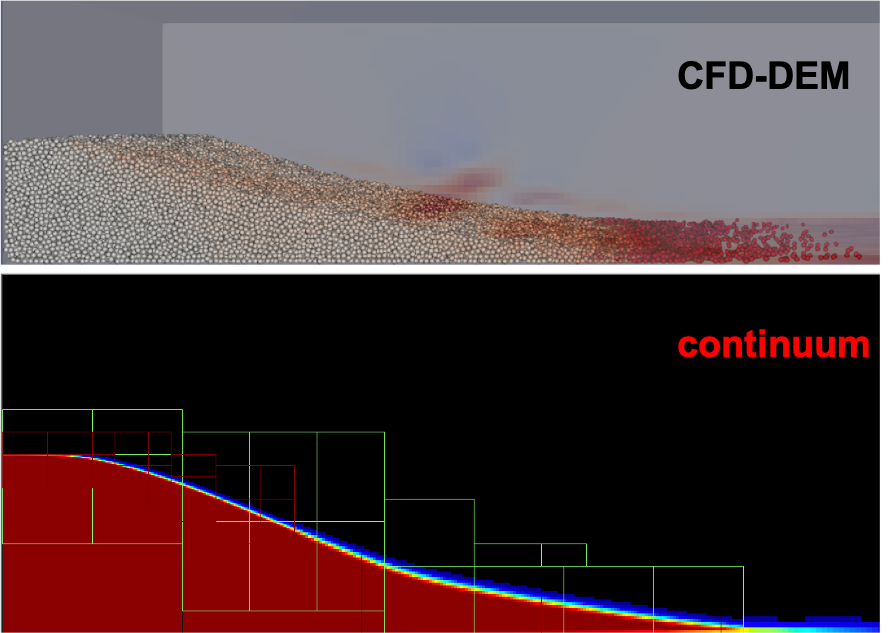
Granular materials and complex fluids, such as dense particle suspensions and non-Newtonian fluid mixtures, are of enormous technological and natural importance. However, they are mathematically very challenging to model, since they can readily switch between solid-like, liquid-like and gas-like states and exhibit complex rheological features; as a result, no universal continuum model currently exists to predict their behavior in general. In our research, we develop constitutive models that connect particle-scale properties with the continuum mechanics of these materials. Particular areas of current interest include continuum modeling of secondary flows and loading-geometry-dependent rheology in dense granular matter, nonequilibrium flow-arrest transitions and jamming in particulate materials, often with distributions of particle sizes and shapes. |
The overarching goal is to develop microstructure-aware constitutive relationships using particle-based modeling and use them to inform continuum modeling of such multiphase complex fluids. We utilize large-scale discrete element method (DEM) and molecular dynamics simulations, along with continuum simulations, including the use and development of low-Mach-number multiphase and Euler-Lagrange models for these materials. We have also developed an adaptive, data-driven numerical method using machine learning to actively couple particle and continuum models within a multiscale simulation. A current application area involves high-fidelity modeling of multiphase bioreactor dynamics towards improving biomanufacturing efficiency (recently funded through the DOE's HPC4EnergyInnovation program).
Selected publications:
- B. Siddani, W. Zhang, A. J. Nonaka, J. B. Bell, I. Srivastava, An Adaptive, Data-Driven Multiscale Approach for Dense Granular Flows, Computer Methods in Applied Mechanics and Engineering, 2025. [doi]
- O. Ayar, B. S. Siddani, I. Srivastava, A. Singh, Recent Computational Advances in Dense Suspension Mechanics, Current Opinion in Colloid & Interface Science, 2026. [doi]
- J. M. Monti, I. Srivastava, L. E. Silbert, A. P. Santos, J. B. Lechman, G. S. Grest, Emergence of Intermediate Range Order in Jammed Packings, Physical Review Letters, 2025. [doi]
- I. Srivastava, L. E. Silbert, G. S. Grest, J. B. Lechman, Viscometric Flow of Dense Granular Materials under Controlled Pressure and Shear Stress, Journal of Fluid Mechanics, 2021. [doi]
- I. Srivastava, L. E. Silbert, G. S. Grest, J. B. Lechman, Flow-Arrest Transitions in Frictional Granular Matter, Physical Review Letters, 2019. [doi]
3. Probabilistic Modeling in Materials Science
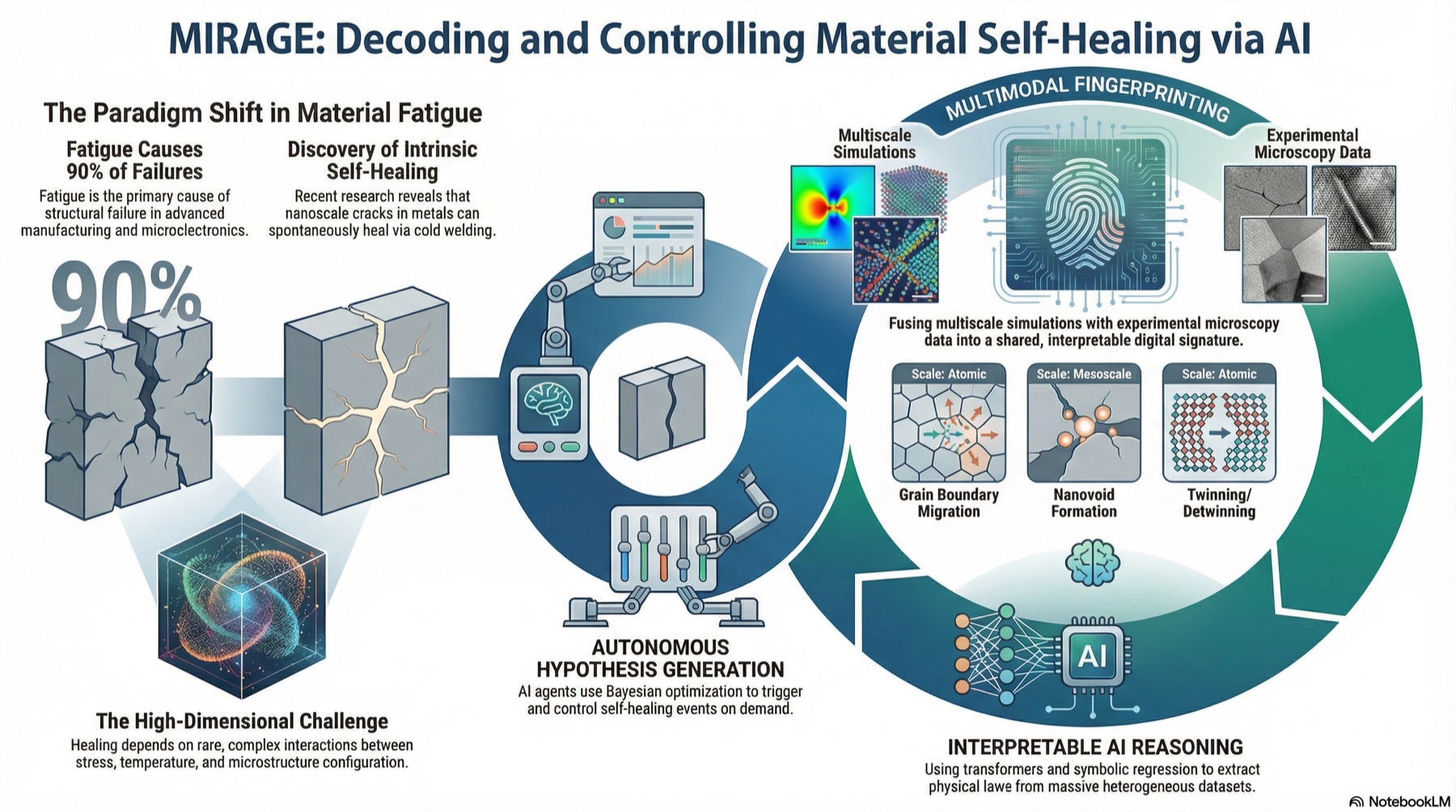
| Materials behavior is often treated as a deterministic mapping from structure to properties, yet many important phenomena emerge from the conditional activation of multiple competing mechanisms across scales. As part of MIRAGE (Microstructure Insights through Reliable/Interpretable AI and Guided Experiments), a multi-institution DOE SciDAC project, we are developing a probabilistic framework that describes materials behavior as an ensemble of constituent mechanisms. The motivating application is fatigue in metals, where crack propagation, arrest, and even self-healing are stochastic processes that can compete depending on local microstructure and loading history. |
|
As part of this effort, we are developing probabilistic scale-bridging methods in which kinetic and thermodynamic quantities of unit mechanisms from atomistic simulations are represented as conditional distributions that are stochastically upscaled to mesoscale simulations such as discrete dislocation dynamics and phase-field models, by incorporating ideas from transition state theory, nonequilibrium sampling and modern methods of generative modeling.
Selected publications:
- B. L. Boyce, M. A. Wood, K. Garikipati, A. E. Robertson, J. Larson, I. Srivastava, et al., R. Dingreville, Materials Behavior as Mechanism Ensembles: A Probabilistic Framework for Emergent Behaviors, submitted, 2026. [arXiv]
Peer-Reviewed Publications
- B. L. Boyce, M. A. Wood, K. Garikipati, A. E. Robertson, J. Larson, I. Srivastava, B. Debusschere, S. Desai, P. Iyer, P. Robbe, M. Cherukara, T. Munson, M. Du, T. Mohanty, D. J. Gardner, L. Capolungo, B. A. Jasperson, J. Tan, R. Dingreville,
Materials Behavior as Mechanism Ensembles: A Probabilistic Framework for Emergent Behaviors,
submitted for publication, 2026.
[arXiv]
- H. T. Jung, H. Kim, A. L. Garcia, A. J. Nonaka, J. B. Bell, I. Srivastava, and C. Kim,
Giant Nonequilibrium Fluctuations at a Reactive Surface,
submitted for publication, 2026
[arXiv]
- B. S. Siddani, J. B. Bell, A. L. Garcia, I. Srivastava,
Capturing non-Markovian Dynamics in non-Equilibrium Stochastic Systems using Flow Matching,
in 2026 Conference on Physics and AI (PAI26), Stanford University, 2026
[arXiv]
- O. Ayar, B. S. Siddani, I. Srivastava, A. Singh, Recent Computational Advances in Dense Suspension Mechanics, Current Opinion in Colloid & Interface Science, 2026 [doi]
- A. L. Garcia, J. B. Bell, A. Nonaka, I. Srivastava, D. Ladiges, C. Kim, An Introduction to Computational Fluctuating Hydrodynamics, arXiv, 2406.12157, 2026 (accepted for publication in SIAM Review) [arxiv]
- J. M. Monti, J. T. Clemmer, I. Srivastava, L. E. Silbert, G. S. Grest, J. B. Lechman, Reverse Segregation and Self-Organization in Inclined Chute Flows of Bidisperse Granular Mixtures, Physical Review E, 113, 035413, 2026 [doi]
- H. T. Jung, H. Kim, A. L. Garcia, A. J. Nonaka, J. B. Bell, I. Srivastava, and C. Kim, Thermodynamically Consistent Incorporation of the Langmuir Adsorption Model into Compressible Fluctuating Hydrodynamics, Journal of Chemical Physics, 164, 094103, 2026 [doi]
- I. Srivastava, A. J. Nonaka, W. Zhang, A. L. Garcia, and J. B. Bell, Molecular Fluctuations Inhibit Intermittency in Compressible Turbulence, Journal of Fluid Mechanics, 1022, A39, 2025 [doi]
- B. Siddani, W. Zhang, A. J. Nonaka, J. B. Bell, I. Srivastava, An Adaptive, Data-Driven Multiscale Approach for Dense Granular Flows, Computer Methods in Applied Mechanics and Engineering, 446, 118294, 2025. [doi]
- R. M. McMullen, M. A. Gallis, I. Srivastava, A. J. Nonaka, J. B. Bell, A. L. Garcia, Comment on "Physical Significance of Artificial Numerical Noise in Direct Numerical Simulation of Turbulence", arXiv, 2025. [arXiv]
- J. M. Monti, I. Srivastava, L. E. Silbert, A. P. Santos, J. B. Lechman, G. S. Grest, Emergence of Intermediate Range Order in Jammed Packings, Physical Review Letters, 134(22), 228201, 2025 [doi]
- M. Polimeno, C. Kim, F. Blanchette, I. Srivastava, A. L. Garcia, A. J. Nonaka, J. B. Bell, Thermodynamic Consistency and Fluctuations in Mesoscopic Stochastic Simulations of Reactive Gas Mixtures, The Journal of Chemical Physics, 162, 154107, 2025. [doi]
- I. Srivastava, A. P. Santos, J. M. Monti, J. T. Clemmer, J. B. Lechman, G. S. Grest, L. E. Silbert, On the Role of Friction and Particle Size Distribution in Granular Packings, Packing Problems in Soft Matter Physics: Fundamentals and Applications, published by the Royal Society of Chemistry, vol. 27, ch. 11, 2025 [doi]
- A. H. Clark, I. Srivastava, Modeling Flow Arrest Transitions in Granular Media, IEEE Computer, 58(1), 2025 [doi]
- A. P. Santos, I. Srivastava, L. E. Silbert, J. B. Lechman, G. S. Grest, Protocol-Dependent Frictional Granular Jamming Simulations: Cyclical, Compression, and Expansion, Frontiers in Soft Matter, 3, 2023. [doi]
- J. M. Monti, I. Srivastava, L. E. Silbert, J. B. Lechman, G. S. Grest, Fractal Dimensions of Jammed Packings with Power-Law Particle Size Distributions in Two and Three Dimensions, Physical Review E, 108, L042902, 2023. [doi]
- J. G. Wang, D. R. Ladiges, I. Srivastava, S. P. Carney, A. J. Nonaka, A. L. Garcia, J. B. Bell, Steric Effects in Induced-Charge Electro-Osmosis for Strong Electric Fields, Physical Review Fluids, 8, 083702, 2023. [doi]
- I. Srivastava, D. R. Ladiges, A. Nonaka, A. L. Garcia, J. B. Bell, Staggered Scheme for the Compressible Fluctuating Hydrodynamics of Multispecies Fluid Mixtures, Physical Review E, 107, 015305, 2023. [doi]
- J. M. Monti, J. T. Clemmer, I. Srivastava, L. E. Silbert, G. S. Grest, J. B. Lechman, Large-Scale Frictionless Jamming with Power-Law Particle Size Distributions, Physical Review E, 106, 034901, 2022. [doi]
- D. R. Ladiges, J. G. Wang, I. Srivastava, S. P. Carney, A. Nonaka, A. L. Garcia, A. Donev and J. B. Bell, Modeling Electrokinetic Flows with the Discrete Ion Stochastic Continuum Overdamped Solvent Algorithm, Physical Review E, 106, 035104, 2022. [doi]
- A. P. Santos, I. Srivastava, L. E. Silbert, J. B. Lechman and G. S. Grest, Fluctuations and Power-Law Scaling of Dry, Frictionless Granular Rheology Near the Hard-Particle Limit, Physical Review Fluids, 7, 084303, 2022. [doi]
- I. Srivastava, L. E. Silbert, J. B. Lechman and G. S. Grest, Flow and Arrest in Stressed Granular Materials, Soft Matter, 18, 735, 2022 [doi]
- W. D. Fullmer, R. Porcu, J. Musser, A. S. Almgren, I. Srivastava, The Divergence of Nearby Trajectories in Soft-Sphere DEM, Particuology, 63, 1, 2022. [doi]
- J. T. Clemmer, I. Srivastava, G. S. Grest, J. B. Lechman, Shear is Not Always Simple: Rate-Dependent Effects of Loading Geometry on Granular Rheology, Physical Review Letters, 127, 268003, 2021 [doi]
- I. Srivastava, S. A. Roberts, J. T. Clemmer, L. E. Silbert, J. B. Lechman, G. S. Grest, Jamming of Bidisperse Frictional Spheres, Physical Review Research, 3(3), L032042, 2021. [doi]
- I. Srivastava, L. E. Silbert, G. S. Grest and J. B. Lechman, Viscometric Flow of Dense Granular Materials under Controlled Pressure and Shear Stress, Journal of Fluid Mechanics, 907(A18), 1, 2021 [doi]
- A. P. Santos, D. S. Bolintineanu, G. S. Grest, J. B. Lechman, S. J. Plimpton, I. Srivastava, and L. E. Silbert, Granular Packings with Sliding, Rolling and Twisting Friction, Physical Review E, 102, 032903, 2020 [doi]
- I. Srivastava, D. S. Bolintineanu, J. B. Lechman and S. A. Roberts, Controlling Binder Adhesion to Impact Electrode Mesostructure and Transport, ACS Applied Materials and Interfaces, 12, 34919, 2020. [doi]
- I. Srivastava, J. B. Lechman, G. S. Grest and L. E. Silbert, Evolution of Internal Granular Structure at the Flow-Arrest Transition, Granular Matter, 22(2), 1-8, 2020. [doi]
- J. M. D. Lane, A. P. Thompson, I. Srivastava, G. S. Grest, T. Ao, B. Stoltzfus, K. Austin, H. Fan, D. Morgan, M. D. Knudson, Scale and Rate in CdS Pressure-Induced Phase Transition, AIP Conference Proceedings (Shock Compression of Condensed Matter 2019), 2272(1), 100016, 2020. [doi]
- I. Srivastava, L. E. Silbert, G. S. Grest and J. B. Lechman, Flow-Arrest Transitions in Frictional Granular Matter, Physical Review Letters, 122(4), 048003, 2019. [doi]
- I. Srivastava, B. L. Peters, J. M. D. Lane, H. Fan, K. M. Salerno and G. S. Grest, Mechanics of Gold Nanoparticle Superlattices at High Hydrostatic Pressures, The Journal of Physical Chemistry C, 123(28), 17530, 2019. [doi]
- K. M. Salerno, D. S. Bolintineanu, G. S. Grest, J. B. Lechman, S. J. Plimpton, I. Srivastava and L. E. Silbert, Effect of Shape and Friction on the Packing and Flow of Granular Materials, Physical Review E, 98(5), 050901, 2018. [doi]
- J. M. D. Lane, K. M. Salerno, I. Srivastava, G. S. Grest and H. Fan, Modeling Pressure-Driven Assembly of Polymer Coated Nanoparticles, AIP Conference Proceedings (Shock Compression of Condensed Matter 2017), 1979(1), 090007, 2018. [doi]
- I. Srivastava and T. S. Fisher, Slow Creep in Soft Granular Packings, Soft Matter, 13(18), 3411, 2017. [doi]
- L. Y. Leung, C. Mao, I. Srivastava, P. Du and C. Y. Yang, Flow Function of Pharmaceutical Powders Is Predominantly Governed by Cohesion, Not by Friction Coefficients, Journal of Pharmaceutical Sciences, 106(7), 1865, 2017. [doi]
- R. Kantharaj, I. Srivastava, K. R. Thaker, A. U. Gaitonde, A. Bruce, J. Howarter, T. S. Fisher, A. M. Marconnet, Thermal Conduction in Graphite Flake-Epoxy Composites using Infrared Microscopy, Proceedings of the 16th IEEE Intersociety Conference on Thermal and Thermomechanical Phenomena in Electronic Systems, 1-7, 2017. [doi]
- K. C. Smith, I. Srivastava, T. S. Fisher and M. Alam, Variable-Cell Method for Stress-Controlled Jamming of Athermal, Frictionless Grains, Physical Review E, 89(4), 042203, 2014. [doi]
- I. Srivastava, S. Sadasivam, K. C. Smith and T. S. Fisher, Combined Microstructure and Heat Conduction Modeling of Heterogeneous Interfaces and Materials, Journal of Heat Transfer, 135(6), 061603, 2013. [doi]
- I. Srivastava, K. C. Smith and T. S. Fisher, Shear-Induced Failure in Jammed Nanoparticle Assemblies, AIP Conference Proceedings (Powders and Grains 2013), 1542(1), 86, 2013. [doi]